Solar-Powered Heaters: Why a 2kWh Battery Is Not an Overnight Plan
Check the energy budget before shopping for heat
A solar-charged battery can have enough rated output for a high-wattage load while storing far too little energy to sustain that load overnight. A hypothetical 1,500W heater running continuously for eight hours needs 12,000Wh—well beyond a roughly 2kWh battery.
This guide separates energy arithmetic from a decision to operate a heater. It uses the US Jackery Explorer 2000 v2 as a documented capacity example, not as an approved heater power source. We have not tested the combination, measured heating runtime or evaluated a particular room.
VibePicks may earn a commission if you buy through links on this page, at no extra cost to you.
The US Consumer Product Safety Commission’s heater guidance calls for electric space heaters to plug directly into a wall outlet, never an extension cord or power strip. It also calls for three feet of clearance from combustible materials and switching heaters off when sleeping. This article does not propose an exception or a battery-to-heater connection procedure. Follow the appliance instructions and resolve any intended backup arrangement with the relevant manufacturers or a qualified professional.
Watts and watt-hours answer different questions
Our documented capacity example
| Exact US model | Jackery Explorer 2000 v2 |
| Rated battery energy | 2,042Wh |
| Rated continuous AC output | 2,200W |
| Battery chemistry | LiFePO4 |
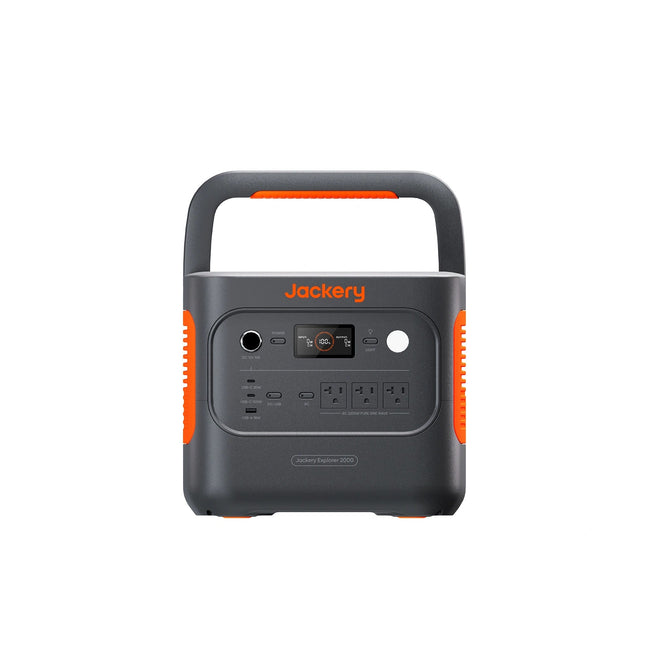
Jackery Explorer 2000 v2 Portable Power Station
The product card shows the capacity example. Prices are omitted; check the current store offer. Its button checks the exact Jackery model’s availability; it is not a recommendation to connect a heater. Do not substitute a similarly named 2000 Pro, 2000 Plus or HomePower model’s specifications.
Calculate a continuous-load scenario
What the assumed energy budget yields
A thermostat changes the calculation, not the safety rules
The word solar does not remove the recharge constraint
Build an outage plan around defined priorities
-
Identify the loads you actually need
Separate room heating from other desired functions. Make an inventory of those devices and their documented requirements; do not infer heating suitability from a list of other appliances a power station can support.
-
Keep a clear energy worksheet
Record wattage, intended duration, assumed usable energy and any charging input separately. Mark estimates as estimates. Our power-station runtime log helps distinguish a measured result from a planning calculation.
-
Resolve the equipment requirements
Use the exact appliance and power-source documentation. Our high-output AC planning guide explains load limits, but a shopping comparison cannot override the appliance’s operating instructions.
Jackery has listed the general code JADEAL for 15% savings and US free shipping, excluding Explorer 240, accessories and refurbished products. Eligibility and stacking for this exact 2000 v2 purchase have not been confirmed, and redemption has not been tested. A reliable expiry date has not been confirmed; this promotion needs a fresh check before relying on it. Check current store conditions and the final eligible total before paying.
Size the plan around energy, not the output headline
- Separate rated watts from stored watt-hours.
- Declare the assumptions behind any runtime figure.
- Keep heater safety requirements ahead of shopping calculations.
A roughly 2kWh battery is a poor starting assumption for an eight-hour continuous 750W or 1,500W heating load. The mismatch is apparent before debating brands. Resolve a safe heating plan separately, then choose backup power for the documented loads and recharge conditions it is actually intended to support.
Rated capacity, output and chemistry: Jackery Explorer 2000 v2 US listing, checked October 8, 2026. Heater precautions: CPSC winter safety guidance, published January 23, 2026. All energy examples in this guide are hypothetical arithmetic.