Can You Fly With a Jackery Explorer 500 v2? Check 512Wh First
VibePicks may earn a commission if you buy through links on this page, at no extra cost to you.
No: the Jackery Explorer 500 v2 is not suitable for passenger-aircraft baggage. Its 512Wh battery is above the 160Wh ceiling in the FAA’s passenger guidance. A compact case, a low charge level or a solar-generator label does not make it an airline-size power bank. Decide how the station will reach your destination before buying it for a trip.
This guide uses current US passenger guidance and Jackery’s published specifications, checked October 19, 2026. It is a documentation-based selection guide, not a flight test or airline approval.
The numbers that answer the flight question
| Explorer 500 v2 battery capacity | 512Wh |
| FAA standard lithium-ion battery limit | 100Wh |
| FAA larger spare battery band, airline approval required | 101–160Wh |
Read watt-hours, not the model name
Jackery identifies the US Explorer 500 v2 as model JE-500A with a 512Wh LiFePO4 battery. The “500” in the name is not the capacity label to show at an airport. Use the actual watt-hour marking and the documentation for the exact version. The older Explorer 500 is a different product; advice or photographs for it should not replace the v2 specifications.
The manufacturer’s Explorer 500 v2 information provides the model and capacity. If your real need is charging a computer after arrival, our 500 v2 USB-C port guide addresses a separate question: which port can supply your laptop.
Carry-on and checked bags do not solve this
The FAA’s passenger battery table says lithium battery powered generators above 160Wh are forbidden on passenger aircraft. The allowance for up to two 101–160Wh spare batteries with airline approval does not extend to a 512Wh station. Spare batteries and power banks otherwise permitted under the guidance belong in carry-on baggage, with protection against damage and short circuits.
Do not pack the Explorer 500 v2 in either checked or carry-on baggage for a passenger flight. Ask your airline about any smaller battery you plan to carry; airlines may impose stricter limits.
Do not assume that draining the station changes its rated capacity. Likewise, do not plan around a removable-battery exception unless the exact equipment and airline rules explicitly support it. A solar panel in a bundle does not change the battery’s rating. Jackery’s own airplane FAQ is another check to make before departure.
Choose a destination plan before a purchase
Separate the journey into two jobs: power for the flight itself and power at the campsite or rental accommodation. For the flight, start with your airline’s current battery policy and a clearly marked, permitted smaller power bank. Check the computer’s input requirements too; buying the right battery size alone does not guarantee the charging performance you need.
For the destination, consider renting suitable equipment locally, borrowing from your host or buying for delivery where the station will stay. Confirm the delivery area, timing, return terms and your onward transport before committing. Shipping a lithium battery is a separate regulated activity; do not treat ordinary parcel or air-cargo shipping as an automatic workaround.
Once transport is resolved, list the devices and hours you actually need. Our camping energy-budget example shows how to organize those assumptions. Its larger station’s figures are not runtime promises for the 500 v2.
An option for ground travel
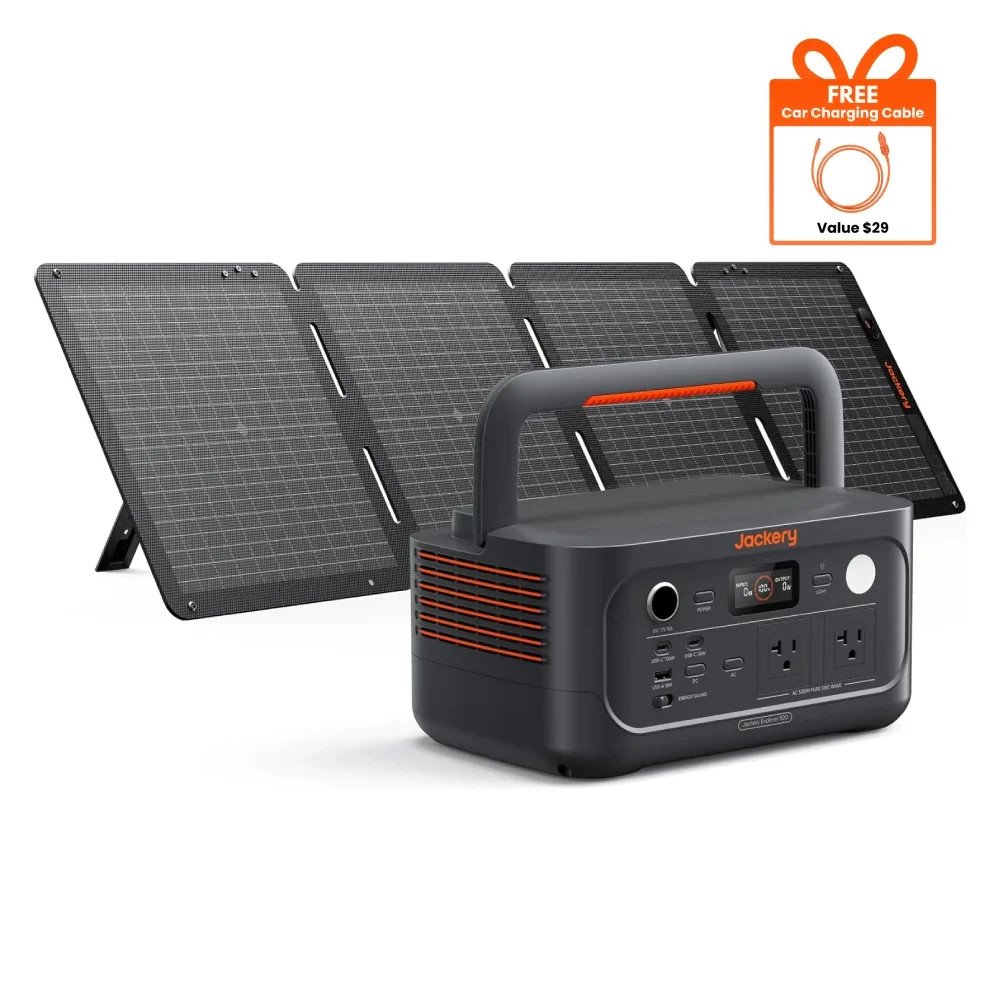
The listing below is the Explorer 500 v2 plus a 100W Air solar panel sold on eBay by Best Outdoor Prodcuts. At our check it was New, Buy It Now, with US delivery subject to the listing’s exclusions. We have not established that this seller is Jackery’s official store. Check the seller’s feedback, delivery coverage and return policy before purchasing; no coupon or guaranteed saving is included here.
The practical decision
Choose the 500 v2 only when you have a suitable ground-transport or destination-use plan. If the station must fly with you as passenger baggage, select a different power solution within the airline’s rules. Resolve that constraint first; capacity, sockets and solar charging become useful comparisons only after the travel plan works.