Anker SOLIX F3000 Expansion: More kWh Does Not Mean More Output
VibePicks may earn a commission if you buy through links on this page, at no extra cost to you.
An expansion battery can help an Anker SOLIX F3000 run a supported load for longer. It does not turn one F3000 into a more powerful inverter. For the US model, Anker lists 3,072Wh of built-in capacity and 3,600W rated AC output. Its expansion table reaches 12,288Wh with three BP3000 batteries attached to one station. Those are different measurements answering different questions: how much energy is stored, and how much power the station can supply at once.
That distinction matters before you buy a battery to solve an overload. If your equipment exceeds an output limit, adding stored energy does not remove that limit. If the equipment works correctly but runs out of energy too soon, expansion may address the actual problem.
This is a documentation-based guide to the US F3000, not a hands-on runtime test. Specifications and expansion counts below come from the Anker F3000 US user guide.
What one F3000 can expand to
Anker’s table lists the following combinations:
One F3000: nominal capacity
The figures describe stored nominal energy. They are not measured energy delivered to an appliance. Conversion losses, the station’s own consumption, reserve settings, temperature and the load profile can affect usable runtime. Do not treat 12,288Wh as a promise of a particular number of hours.
They also describe one station with compatible expansion batteries. A larger advertised system capacity can refer to multiple stations and additional equipment. Check the number of F3000 units and BP3000 batteries included in the exact package before comparing prices.
More storage leaves the output limits relevant
The US manual rates the TT-30R output at 120V, 30A and a maximum of 3,600W. It lists the NEMA 5-20R output at 120V, 20A and a maximum of 2,400W. Read the manual’s port and total limits together; a large battery bank does not make every outlet interchangeable.
Anker separately describes a two-F3000 configuration with its Double Voltage Hub for 240V and up to 7,200W. That is a different system, requiring two stations and the specified accessory. It is not the result of attaching a BP3000 to one F3000. The manual also warns that the hub stops supplying output if one connected station shuts down.
For fixed home integration, ask a qualified installer to confirm the approved equipment, transfer arrangement and load requirements. This article is not a wiring guide. For another limitation that can affect planning, see our explanation of F3000 charging modes and AC output availability.
A planning calculation, not a runtime guarantee
Suppose a load averaged 300W continuously. Dividing 3,072Wh by 300W gives 10.24 hours; dividing 6,144Wh by the same load gives 20.48 hours. These are ideal arithmetic figures before losses and reserve allowances, not expected or tested runtimes. A refrigerator also cycles, so its label wattage should not simply be treated as a constant average.
The useful lesson is the comparison: doubling nominal capacity roughly doubles the energy budget under otherwise similar conditions. It does not establish how long your particular equipment will run. Measure a representative use period, include all simultaneous loads, and keep a margin for uncertainty. Our power-station runtime test log explains how to record a repeatable baseline.
Check the package and the practical burden
First decide whether you need more runtime, more simultaneous output, or a separate power source in another place. These needs can lead to different purchases. Our guide to an extra battery versus a second power station explains that broader trade-off.
Then confirm the exact BP3000 compatibility and connection requirements in the current manuals. Do not substitute a different brand or a similarly named battery. Plan where the complete system will sit and how it will move: Anker lists the F3000 alone at approximately 91.5lb, before any expansion battery is added. More stored energy also means more energy must eventually be replenished; it does not automatically increase charging power.
For any listing, distinguish the standalone F3000 from a bundle. Check included batteries, cables, accessories, seller, returns and delivery exclusions rather than relying on the first product photo. A listing for one station is not a three-battery package merely because its description mentions expansion.
The practical choice
Expand an F3000 when your measured load is within the station’s documented output limits and additional runtime is the missing capability. If the problem is an overloaded outlet, a 240V requirement or power needed in a separate location, resolve that requirement first. Capacity is only one part of the system you are buying.
The linked listing is for the standalone F3000, not a BP3000 expansion package. Checked October 16, 2026: listed as new with Buy It Now and US shipping, subject to exclusions including Alaska and Hawaii. The seller lists no returns. No coupon or bundled gift is assumed here.
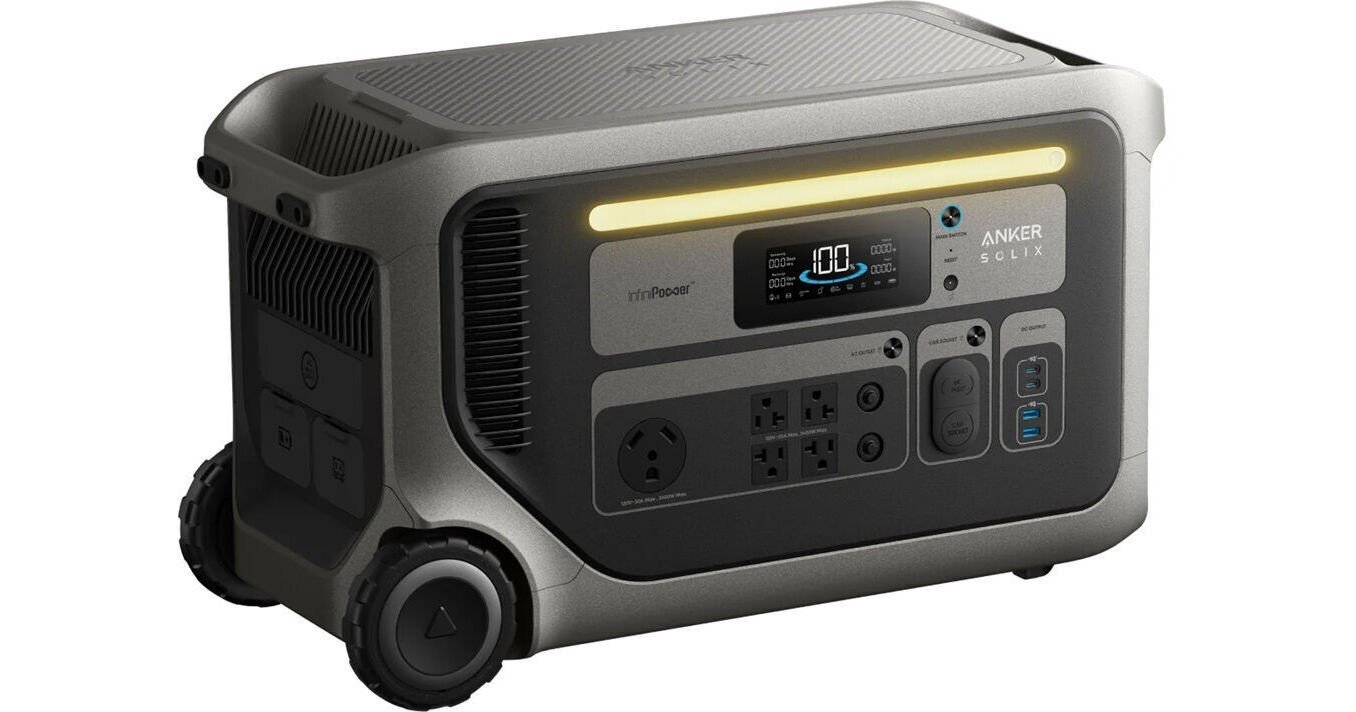
A standalone station for loads within its documented output limits. Expansion batteries are separate; compare the exact package and seller terms before buying.