BLUETTI AC180 Car Charging: Budget Energy Before You Rely on It
VibePicks may earn a commission if you buy through links on this page, at no extra cost to you.
Car charging can add energy to a BLUETTI AC180, but a short charging window is not the same as a full refill. Plan from the input power actually available, the time you can use it and any devices drawing power at the same time. The 1,800W output rating does not describe its vehicle charging speed.
This is a document-based planning guide for the US AC180 with 1,152Wh capacity. It is not a charging test. The AC180P and solar bundles are separate selections; do not transfer their specifications or delivery dates to the base AC180.
Keep these numbers separate
Start with energy, not the output label
Watts describe a rate; watt-hours describe an amount of energy. For a simple planning estimate, multiply average input watts by charging hours. Use a realistic average for your actual setup rather than borrowing an AC charging claim, a solar-input limit or the output rating printed on the front of the station.
For example, an assumed steady 100W input for two hours supplies 200Wh at the input. Dividing 200Wh by the AC180’s nominal 1,152Wh gives about 17.4%. That is a gross comparison before conversion losses, the station’s own consumption or connected loads. It is not a prediction of the percentage increase on the display, and 100W here is an example assumption, not a measured or guaranteed vehicle charging rate.
100W × 2h = 200Wh supplied before losses and loads. A short top-up should not be planned as a full recharge of a 1,152Wh station.
A partly charged battery, a changing input rate or a temperature-related limit can change the result. Record the starting charge and the input shown by the station when assessing your own setup. If the power varies, a single momentary reading is a weak basis for an entire afternoon’s plan.
Subtract the work you ask it to do
Charging and energy storage are not identical if you also use the outputs. As a simplified illustration, a 60W load running throughout that same two-hour period consumes 120Wh. The arithmetic balance is then only 80Wh before all losses and other consumption. The real battery change depends on the power paths and operating conditions; this example is a budgeting aid, not a pass-through efficiency claim.
That distinction matters when you expect to arrive with enough reserve for a later task. Count both the energy you hope to add and the energy you will spend before that task begins. For small loads, also read our AC180 ECO-mode guide; an output shutting down is a separate question from how much energy remains.
Vehicle charging still needs a compatibility check
The manufacturer’s manual describes charging from a vehicle’s 12V cigarette-lighter outlet with the car charging cable. It also requires a secure connection and use of genuine accessories. Check the vehicle handbook for the outlet’s limits and operating conditions, and confirm the correct cable for this exact station. Do not substitute assumptions about a different vehicle or a different BLUETTI model.
The AC180 manual also cautions against moving the unit during operation. Ask BLUETTI for model-specific clarification before relying on charging in a moving vehicle. This guide is not an installation or wiring procedure.
Do not build a trip plan around leaving a vehicle running solely to refill a station. Decide on a charging arrangement permitted by both manufacturers, with suitable placement and ventilation. If the ordinary vehicle outlet cannot supply the energy you need in the available time, change the charging plan rather than improvising wiring or bypassing protections.
Choose the refill plan before the purchase
Compare the energy required after charging with the reserve already available. If the gap is hundreds of watt-hours, a short top-up may help but still leave a substantial deficit. Our AC180 and DELTA 2 Max capacity and solar comparison explains another charging context; its solar figures must not be reused as vehicle charging figures.
The US store listed the base AC180 as available when checked on October 17, 2026. A separate solar-bundle notice gave a later panel shipping date, so check the selected package and destination before ordering. No coupon or product-specific saving is promised here. This product card is checked manually and directs you to current availability.
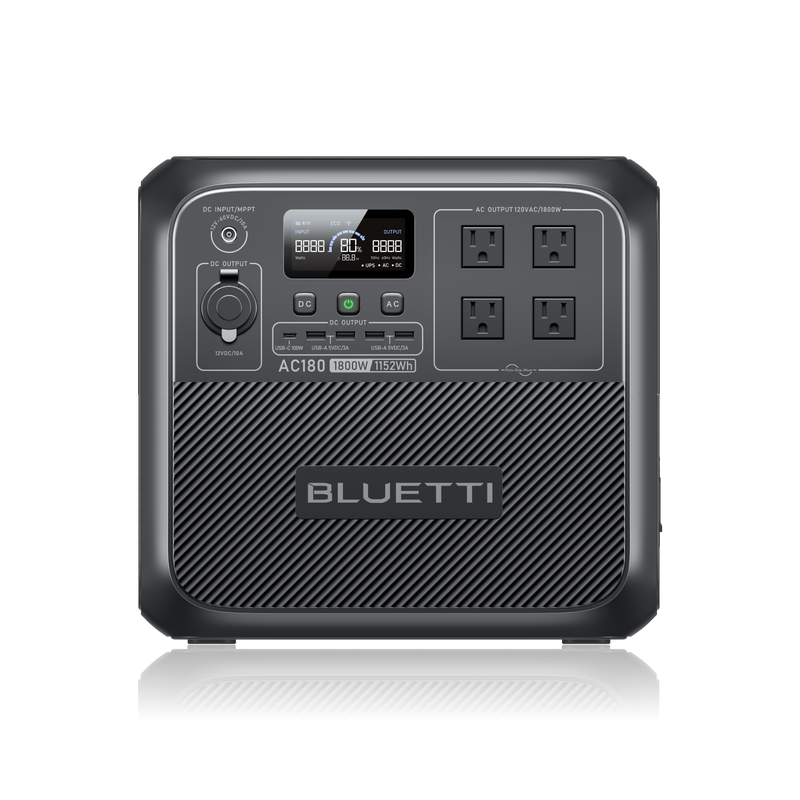
Practical conclusion: treat vehicle charging as an energy-budget question. Confirm the permitted setup, estimate input over the actual charging window, account for loads and losses, and keep a reserve instead of treating a short session as a full refill.
Primary technical source: BLUETTI AC180 user manual, particularly safety instructions, specifications and section 4.3.3 on car charging.