VTOMAN FlashSpeed 1500: Why Its Two DC Inputs Have Different Limits
VibePicks may earn a commission if you buy through links on this page, at no extra cost to you.
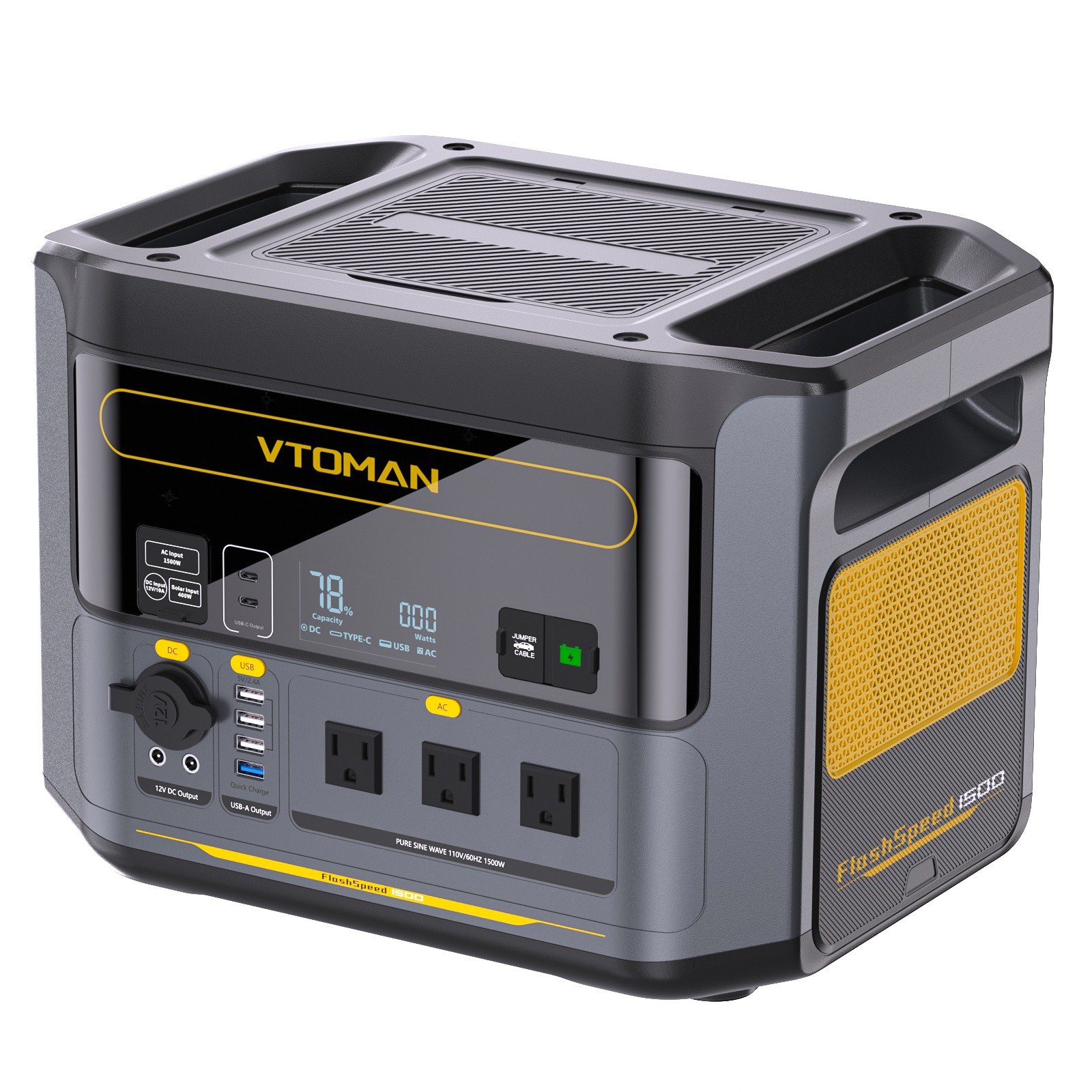
The US VTOMAN FlashSpeed 1500 has two separate low-voltage charging inputs: an Anderson solar input rated for 30–60V and up to 400W, and a DC input rated for 12–20V and up to 200W. A panel or cable fitting one socket does not establish that it is suitable for the other. Check the input label, panel specifications and manufacturer-approved connection before buying an adapter.
This is a guide based on the PB-58 manufacturer manual, rather than a hands-on charging test. It covers the 1548Wh FlashSpeed 1500, not the Jump 1500X, an expansion battery alone, or a bundle whose contents are unclear.
Two inputs, two electrical ranges
Start with the socket, then check the panel
The solar section of the manual specifies a panel working voltage between 30V and 60V for the Anderson input. It also requires an Anderson connection, whether supplied with the panel or provided by the correct adapter. That makes connector shape and electrical suitability separate checks. An adapter changes the connection; it does not raise a low-voltage panel into the required operating range.
For example, a hypothetical panel with an 18V working voltage falls outside the Anderson input’s stated 30–60V range, even if its cable can be adapted. That example does not certify the same panel for the lower-voltage DC socket: the manual describes that socket for car charging, and the panel’s full electrical characteristics and approved connection would still need checking.
Use the exact panel datasheet, including working voltage and open-circuit voltage, and obtain manufacturer confirmation if the limits or cable polarity are unclear. Do not infer that a panel is suitable because its marketing name says “12V,” “200W,” or “universal.” Our solar-panel compatibility checklist explains the information to collect before matching a panel to a station.
Confirm the exact panel, voltage limits, polarity and approved cable with VTOMAN before connecting equipment. This guide does not provide a series/parallel wiring plan or certify third-party panels.
400W is an input ceiling, not a charging promise
A 400W input rating does not mean the station receives 400W throughout the day. Sun angle, shading, weather, panel temperature and charging control affect the power that reaches the battery. The manual describes approximately four to eight hours with the VS400 panel, depending on sunlight. Treat that as a manufacturer estimate for its stated setup, rather than a result for any 400W array.
A simple energy calculation shows why expectations matter. Dividing the 1548Wh nameplate capacity by a hypothetical constant 400W input gives 3.87 hours. This deliberately idealized calculation excludes conversion losses, changing sunlight and charging taper; it is not a full-charge forecast. If appliances run while charging, they also consume energy that would otherwise increase the stored charge.
The same distinction appears in our P300 panel-versus-input-limit example: panel wattage and the receiving station’s limit describe different parts of the system. The limits for that model must not be transferred to the FlashSpeed 1500.
Keep car charging separate from the solar plan
The manual lists the DC input at 12–20V and 200W maximum, then describes car charging using the supplied car cable. It estimates roughly 12–14 hours for that method. The socket’s maximum rating therefore should not be read as a guarantee that a vehicle accessory outlet supplies 200W. Check the vehicle outlet and cable ratings and follow both manufacturers’ instructions.
Plan a solar purchase around the documented Anderson input. If you intend to use a different source at the DC socket, ask VTOMAN about that exact source and cable rather than combining the two voltage ranges into a supposed universal 12–60V input.
Buying the station rather than an extra battery
The checked eBay listing is item 315467193967, sold by VTOMAN SHOP, and describes the FlashSpeed 1500 station with 1548Wh capacity. At the October 22, 2026 check it was New, offered Buy It Now and showed nine available, located in California with shipping to the United States. Alaska/Hawaii, PO boxes and APO/FPO were excluded. The seller showed 99.2% positive feedback and did not accept returns. Recheck the current listing and your delivery eligibility before ordering.
A separate extra battery cannot replace the station. Confirm the item title, included cables and photographs, particularly where search results mix station and expansion-battery descriptions. Also confirm warranty coverage for the sales channel: the PB-58 manual limits its stated warranty to purchases through the VTOMAN website or Amazon, so this guide does not promise that coverage for an eBay purchase. A visible sale price does not establish an additional coupon; no coupon saving is assumed here.
The practical decision
Choose this model only after your proposed charging source passes the checks for its particular input. For a solar setup, begin with the 30–60V Anderson specification and the exact panel documentation. For vehicle charging, use the documented car-charging method and realistic timing. Resolving those details before buying is more useful than choosing an adapter on connector shape alone.
Primary technical source: VTOMAN FlashSpeed 1500 PB-58 user manual, specifications and sections 5.2 and 6. Manufacturer documentation checked October 22, 2026.