Growatt INFINITY 2000 PRO for RVs: What the TT-30 Outlet Can Power
VibePicks may earn a commission if you buy through links on this page, at no extra cost to you.
A convenient RV connector still has a power limit
The US Growatt INFINITY 2000 PRO has a TT-30 outlet, but its manual rates total continuous AC output at 2,400 W across all five AC outlets. Plan around the shared power budget, then calculate how long your selected loads could run.
This is a document-based buying guide, not a hands-on RV test. It covers the US PRO model, not the older INFINITY 2000.
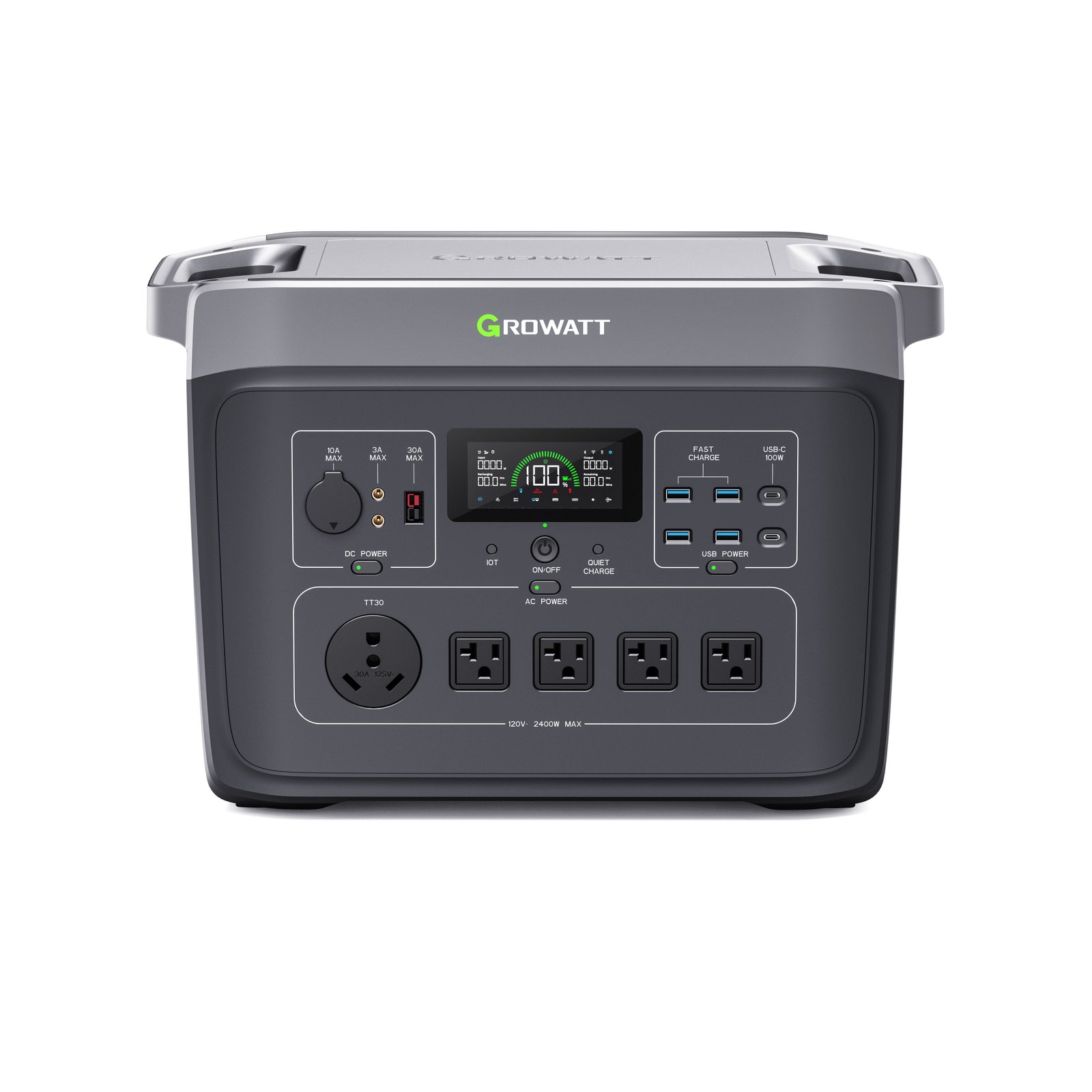
Check the exact US model and its manual before choosing it for your RV. The connector alone does not establish compatibility with your vehicle.
What the TT-30 outlet does—and does not—tell you
The manufacturer’s US manual lists four standard AC outlets and one TT-30 outlet sharing a 2,400 W total rating at 120 V. A nominal 30 A campground supply at 120 V represents 3,600 W by simple voltage-times-current arithmetic. Those two power budgets are different. The shape of the socket does not turn this battery station into the equivalent of that campground supply.
The store’s navigation also contains a 2,200 W label, while its specifications and the US manual list 2,400 W. We use the manual’s total rating here; ask Growatt to confirm the specification for the exact unit offered before purchase. Do not resolve that discrepancy by assuming a larger output or treating a peak rating as sustained power.
US manual: the numbers that matter
| Nominal battery energy; LiFePO4 | 2,048 Wh |
| Continuous AC output shared by four outlets and one TT-30 | 2,400 W total |
| US AC output | 120 V |
| Listed net weight | 51 lb / 23 kg |
| Listed solar input voltage range | 12–60 V |
| Listed solar input power limit | 1,200 W max |
Specifications above come from the INFINITY 2000 PRO US user manual, specification page 17. They are manufacturer ratings, not measured performance from our testing.
Build a load budget for the RV you actually use
Start with the appliances you want to operate together. Include any RV converter or battery charger that will draw power when the vehicle is connected. That background load can consume part of the station’s output even when the obvious appliances seem modest.
Separate running demand from startup demand. A refrigerator compressor or air conditioner may need more power to start than to continue running. This guide does not establish that your air conditioner will start successfully. For a microwave, use electrical input demand rather than its advertised cooking output. Appliance names and a single headline wattage are not enough to establish compatibility.
As a hypothetical budgeting example, 200 W of equipment plus a 60 W fan and 90 W laptop totals 350 W before any additional converter demand. These are invented planning inputs, not measurements of specific appliances. Replace them with your own documented or measured loads; our power station runtime test log explains how to keep the assumptions visible.
Ask a qualified RV technician to check the station, shore-power connection, grounding and protective arrangements against the vehicle’s requirements. A matching connector does not prove the entire setup is suitable. Follow both manuals; this guide does not provide vehicle wiring or household backfeed instructions.
Estimate energy separately from output power
A load can fit within the output rating and still drain the battery sooner than you want. For illustration only, assume 80% of the nominal 2,048 Wh reaches the loads: that is 1,638.4 Wh. Divide that assumed usable energy by a steady average load to estimate runtime.
Illustrative runtime—not a measured result
| Assumed 250 W average load; 80% usable energy | 6.55 hours |
| Assumed 500 W average load; 80% usable energy | 3.28 hours |
The 80% factor is a planning assumption, not a Growatt efficiency specification. Actual runtime depends on load cycling, conversion losses, station consumption, temperature and battery condition. These estimates do not guarantee overnight refrigerator operation. They also do not establish runtime with optional expansion batteries.
Charging and carrying can decide whether it fits
The solar input’s maximum rating is a ceiling, not a promise of sustained production. A panel setup must satisfy the manual’s electrical limits, not merely have a matching wattage total. Check the documented panel and station specifications before buying an array. For a broader planning sequence, see our portable power station setup guide for camping and blackouts.
At the listed 51 lb weight, decide where the station will travel and whether you can move it safely. Check the proposed storage space, access and ventilation against the manual. A larger energy reserve helps only if the unit fits your trip and you can recharge it on a realistic schedule.
The standalone US PRO model was listed as available when checked. We found no verified discount code with confirmed conditions for this model, so no coupon or saving is promised here. Recheck the store’s current availability and terms before ordering; this manually maintained product listing is not a live price guarantee.
Choose it around selected loads
- Confirm the US PRO model and its output rating with the manufacturer.
- Account for simultaneous appliances, startup demand and the RV converter.
- Treat runtime calculations as estimates and verify the vehicle connection before use.
The TT-30 outlet may make the US INFINITY 2000 PRO worth investigating for an RV, provided the vehicle connection is suitable. Make the purchase decision from the shared output limit, a realistic energy budget and the exact unit’s confirmed specifications—not the connector’s name alone.