Jackery Explorer 1000 v2 Camping: Build a Daily Energy Budget
The Jackery Explorer 1000 v2’s 1070Wh capacity is a useful starting point for a camping plan, but it is not a promise to run every item on your packing list for a day. Build a load budget first. A small refrigerator operating around the clock can use more energy than your lights, phone and laptop combined, even when its average power looks modest.
VibePicks may earn a commission if you buy through links on this page, at no extra cost to you.
US Explorer 1000 v2: two different limits
Write the day in watt-hours
Watts describe power at a moment; watt-hours describe energy over time. Multiply a device’s average watts by its operating hours. A device that averages 25W for 24 hours uses 600Wh. A 60W load used for two hours uses 120Wh. The smaller wattage can therefore create the larger daily energy demand.
For cycling equipment such as a compressor refrigerator, do not substitute its brief running-watt reading for a full-day average. Measure energy over a representative period at the temperature and settings you expect to use. Our fridge and freezer power-station sizing guide explains the checks to gather before choosing capacity.
| Example load | Assumption | Daily energy |
|---|---|---|
| Lights | 8W × 5h | 40Wh |
| Phone charging | 15W × 2h | 30Wh |
| Laptop | 60W × 2h | 120Wh |
| Camping fridge | 25W average × 24h | 600Wh |
| Total | One hypothetical day | 790Wh |
Every load and duration in this example is an assumption. The 25W fridge average is not a measured result for a particular refrigerator or campsite. We have not tested this station’s runtime.
Keep reserve and losses separate
Suppose you choose to retain a planning reserve equal to 20% of nominal capacity. That leaves 1070Wh × 0.8 = 856Wh on paper before losses. Compared with the example’s 790Wh demand, the difference is only 66Wh. That small gap is not evidence that the plan will work: conversion losses, the station’s own consumption and changing device demand still have to fit.
For a sensitivity check, assume that 85% of that 856Wh reaches the loads. The result is about 728Wh, below the example’s 790Wh demand. The 85% figure is an illustrative assumption, not a measured efficiency for the Explorer 1000 v2. Different output paths and loads have different losses. The point is to test whether your plan survives less favorable assumptions, then replace them with observations.
Cutting the fridge assumption from 25W average to 20W would reduce its daily demand by 120Wh. That shows why measuring a continuous load is more useful than debating a few minutes of phone charging. Use the power-station runtime test log to record the actual load, starting charge, elapsed time and finishing charge before relying on the setup for a trip.
Check peak power independently
Jackery’s US technical information lists 1500W total rated AC output across the three outlets. Three sockets do not mean three independent 1500W supplies. Add simultaneous AC loads, check each device’s starting requirements and consult the exact station documentation. A daily watt-hour budget cannot establish whether a compressor or another motor will start successfully.
This guide covers Explorer 1000 v2, not the similarly named HomePower 1000 v2, original Explorer 1000 or Explorer 1000 Plus. Their specifications do not transfer automatically. For the US model and output limits, use Jackery’s Explorer 1000 V2 technical information, updated August 20, 2026.
Plan the next charging opportunity
A one-day budget becomes a two-day shortfall if you repeat the loads without replacing their energy. Identify when you will have a documented charging source and how much energy it can realistically add. Sunshine, a panel’s advertised watts and a station’s maximum input are separate quantities; do not count an unmeasured solar day as a guaranteed refill.
The black, station-only US variant was available when checked on October 13, 2026. The store’s shipping policy covers the contiguous US and excludes Alaska, Hawaii, Puerto Rico and the US Virgin Islands; it also excludes PO Box and military-mail addresses. Check your delivery address and package contents before buying. We omit price and coupon claims because offers can change, and the listed affiliate codes’ application and stacking were not confirmed. No checkout test was performed.
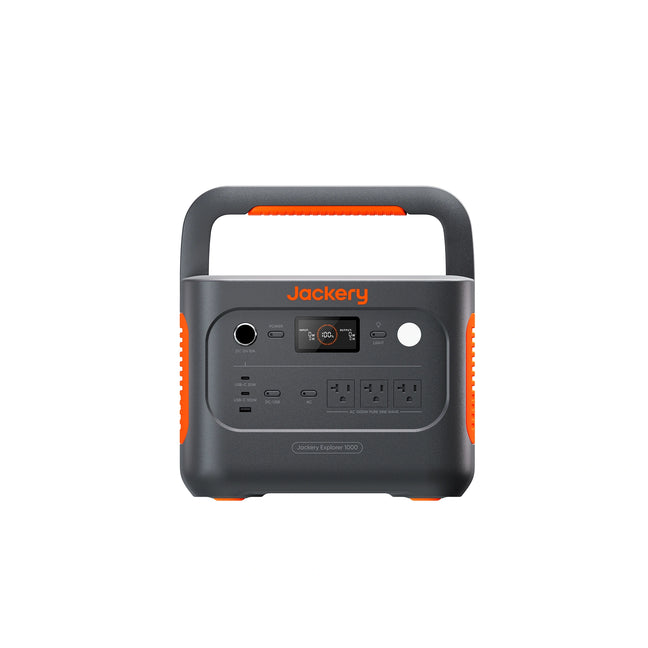
A station-only option to assess against your measured daily loads, output requirements and charging opportunities. Check the exact US variant and delivery terms.
Practical choice: choose capacity after measuring your longest-running load, keep a deliberate reserve, and check power limits separately. In this example, the fridge dominates the budget and the loss allowance decides whether the plan has enough margin. A bigger headline capacity cannot replace those checks.