BLUETTI Elite 30 V2 Solar Input: Check 28V Before Panel Watts
VibePicks may earn a commission if you buy through links on this page, at no extra cost to you.
Panel watts are only one part of compatibility
The US BLUETTI Elite 30 V2 accepts up to 200W of solar input, but its documented input window is 12V–28V with a 10A maximum. A panel advertised as “200W” can still fail the voltage check.
This is a document-based compatibility guide for the US model, not a charging-speed test. Use the exact panel specification and the power station manual before buying.
Start with the DC input limits
These figures are from the Elite 30 V2 US user manual V3.0, charging section and specifications. Its opening warning says not to use a panel whose open-circuit voltage is higher than 28V. Do not substitute the limits of another Elite model.
Read open-circuit voltage, not just the product title
A panel listing may highlight its wattage and a familiar nominal system voltage. Neither label replaces the panel’s electrical specification. Find the manufacturer’s open-circuit voltage, commonly written Voc, and keep it separate from maximum-power voltage, commonly written Vmp. The station manual’s warning specifically concerns open-circuit voltage.
For an illustrative screening example, suppose one panel is labelled 200W with a Voc of 36V. The wattage matches the station’s headline input ceiling, but 36V exceeds 28V, so that panel fails this check. A different hypothetical panel with a Voc of 24V clears that one comparison, but current, connectors and the remaining manufacturer requirements still need checking. These numbers are examples, not recommendations for an unnamed panel.
Do not connect a panel that exceeds the station’s voltage limit, improvise an adapter or alter the wiring to make a connector fit. Ask the manufacturer to confirm the exact panel and cable combination if any specification is unclear.
Treat the complete panel setup as the item to verify
If you are considering more than one panel, a single panel’s label does not describe the complete setup. The configuration can change the electrical characteristics seen at the input. Get the intended combination confirmed against the station’s limits rather than assuming that two individually suitable panels remain suitable together.
Also ask how the panel manufacturer specifies open-circuit voltage across the temperatures where it will be used. A warm-weather figure alone is not a reason to operate near a hard ceiling without the manufacturer’s confirmation. This guide gives purchasing checks, not series/parallel wiring instructions. Our solar panel compatibility checklist organizes the information to collect.
Do not turn a 200W limit into a charging-time promise
The 200W figure is an input limit, not a promise of continuous production from a 200W panel. The actual setup must be compatible first; then sunlight, panel conditions and the station’s charging controls affect incoming power. Plan around observed input for your conditions instead of assuming the nameplate wattage will persist throughout the day.
Likewise, the 288Wh capacity is stored energy, while solar watts describe a power rate. Dividing those two labels alone leaves out changing input and charging losses. It is a rough arithmetic exercise, not a verified refill time. If a trip depends on a particular charging window, leave a fallback that does not require the panel to sustain its rated output.
Check the cable and bundle delivery before departure
The manual lists the solar charging cable as an optional accessory rather than part of the standard package. Confirm the exact included cable for the version you order. On October 18, 2026, the US store’s 100W solar bundle also carried a notice that its solar charging cable would start shipping in late October, while other items would ship as usual. A delivered station and panel do not necessarily mean the complete solar setup has arrived.
The card below links to the US Deep Grey base unit, SKU EL30V2-US-GY-BL-SPFUS-00, which the store showed available when checked. US delivery has exclusions, including Alaska and Hawaii; confirm your destination and any accessory lead time. No model-specific coupon is recommended here. A general promotion for selected larger bundles does not establish a discount or free accessory for this unit.
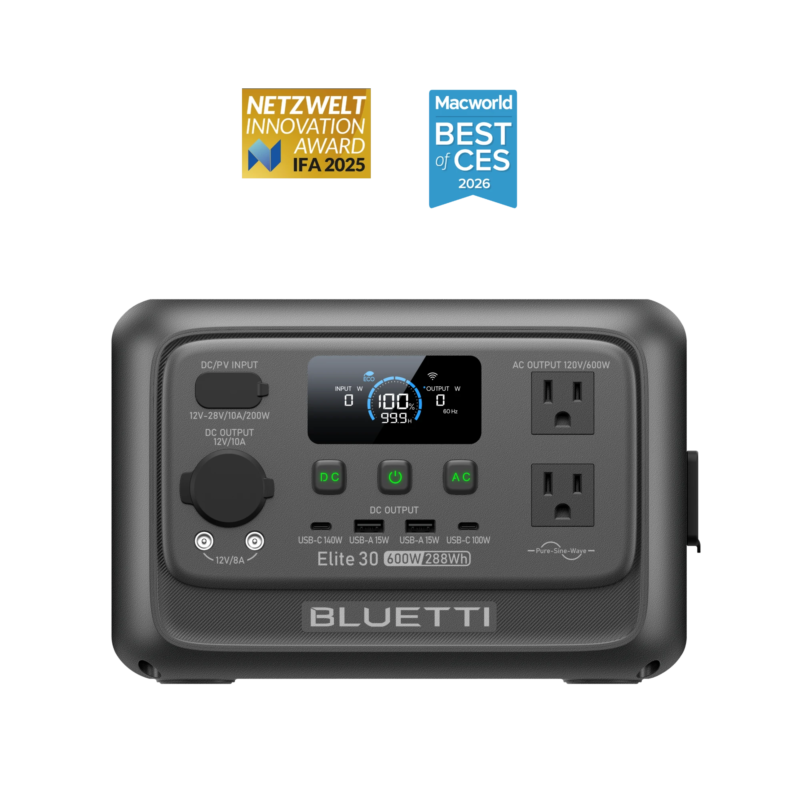
Confirm the solar cable and exact panel compatibility separately. Check current US availability and delivery terms.
Solar input and appliance output are separate checks. For the station’s output limits, see our Elite 30 V2 Power Lifting explanation before treating the 1,500W marketing figure as a continuous output rating.
Keep a panel approval record before departure
| Entry | Evidence to retain |
|---|---|
| Panel and station identity | Panel model/revision, US station label and matching manual pages |
| Complete electrical comparison | Voc with temperature guidance, current/power limits and the approved configuration |
| Connection and delivery | Exact cable/adapter reference, bundle contents and confirmed lead time |
| Trip energy | Required Wh, realistic charging window, observed input and poor-weather fallback |
A blank row is a question to resolve, not evidence that the pairing works. For the complete carrying and poor-weather decision, use the foldable camping-panel selection record. This table does not approve an unnamed panel or promise a recharge time.
Approve the electrical match before comparing watts
Start with the exact panel’s Voc and the Elite 30 V2’s 28V ceiling, then verify current, cable, complete configuration and delivery. Only after those checks does a higher panel wattage become a useful purchasing comparison.