LiTime Group 24 Self-Heating Battery: What Happens Before Charging Starts?
VibePicks may earn a commission if you buy through links on this page, at no extra cost to you.
A self-heating battery can use incoming power to warm its cells before charging them. That changes how you should plan a cold morning: an active charger does not necessarily mean the battery is already gaining charge.
This guide covers the US LiTime 12V 100Ah Group 24 Smart Self-Heating battery with LiHeat dual-mode heating. It is a document-based explanation, not a cold-chamber test. Check the exact version supplied: a Group 24 case size alone does not identify the heating system.
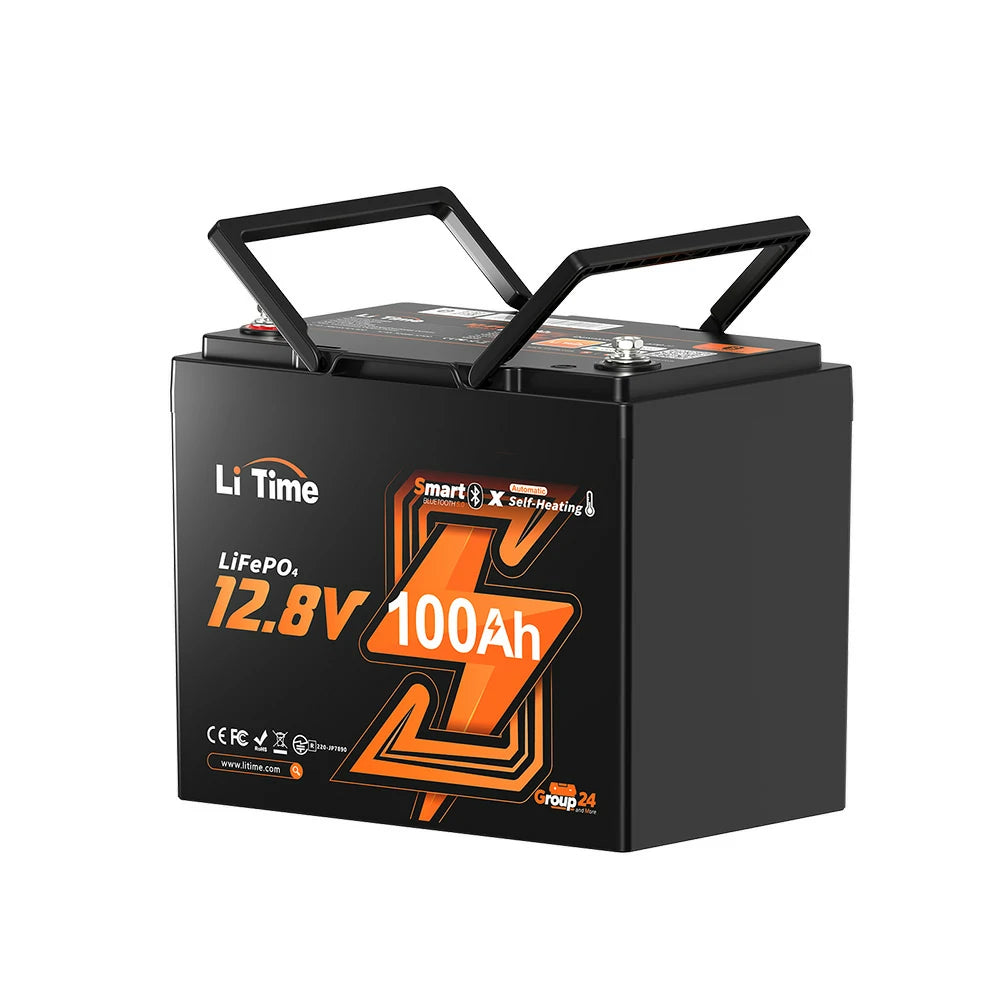
Check the LiHeat version, charger requirements and current US availability before choosing it for cold-weather storage.
Heating and charging are separate jobs
In regular mode, LiTime specifies a charger supplying at least 10A for the heating system. In energy-efficient mode, a charger below 10A can be supplemented by stored battery energy when the state of charge is above 20%. The company also describes battery-powered heating without a charger above that same threshold. These are conditions for this model, not universal rules for lithium batteries.
That distinction matters with a small solar charging source. Output can fall with shade or changing sunlight; the advertised maximum current of a controller is not proof that it is supplying that current now. A battery that contributes energy to its own heater may become warmer while its stored-energy balance improves slowly—or falls. Watch temperature and state of charge together instead of interpreting an illuminated charger as a successful recharge.
The relevant manufacturer conditions
Budget for warm-up before the useful charging window
Consider a purely illustrative energy budget: a heater drawing 100W for one hour would use 100Wh. Against a nominal 1,280Wh battery, that is about 7.8%. This arithmetic is not a measured heating cycle, a prediction of the time needed to warm this battery, or a claim about how much energy comes from the battery rather than the charger. Actual conditions and the selected mode determine those details.
The useful lesson is to keep warm-up time separate from your recharge calculation. If you only have a brief midday solar window, a plan based entirely on nominal amp-hours and charger amperage can be too optimistic. After the battery reaches a permitted charging temperature, normal charging still takes time and may taper. Our 100Ah recharge-time guide for a 20A charger explains the charging assumptions to check after warm-up.
Self-heating does not mean the cells can accept charge at any temperature. Follow the manual and BMS limits for the exact supplied battery. Do not bypass protection or use an unapproved external heating arrangement.
Before relying on it during an RV trip
Confirm the label and manual match the current LiHeat model, then check the charger profile and current capability. Ask LiTime how your charging source behaves during heating if its output is variable. Record the starting battery temperature, state of charge, selected mode and observed input before assessing a slow recharge. Ambient temperature alone is an incomplete description of what the cells are experiencing.
Also keep a reserve for the loads you actually need. Self-heating consumes energy; it does not enlarge the battery. A nearly depleted battery cannot be assumed to meet the above-20% condition for battery-assisted heating. For broader planning, our cold-weather charging and temperature checklist covers the differences between storage, discharge and charging limits.
Keep a cold-morning observation record
| Record at the same time | Why it changes the interpretation |
|---|---|
| Exact model, selected mode and document reference | Prevents applying another Group 24 battery’s heating rules |
| Battery-reported temperature and state of charge | Separates cell condition and reserve from ambient air temperature |
| Observed charging source output and active loads | Separates a charger’s rating from available incoming power |
| Later temperature/SOC at a stated elapsed time | Shows the direction of the energy balance without inventing a warm-up duration |
Keep an unexpected result unresolved and consult the matching documentation or manufacturer. For comparison with a protection-only approach, the Redodo Ultra-Mini versus Group 24 Basic guide distinguishes charging cutoff from self-heating. It is a different product family, not an alternative set of settings for LiHeat.
Source and purchase checks
The specifications and mode conditions above come from LiTime’s US product documentation, checked October 11, 2026. The page provides a manual under User Manual; use it to verify your supplied revision. Availability was visible in the US store at that check. We have omitted a fixed price and a discount promise because these require a fresh check at purchase time.
Choose around the charging source
The practical question is whether your charger and energy reserve can support the heating mode you intend to use. Confirm the exact model, allow time and energy for warm-up, and judge charging by the battery’s reported condition rather than a charger light alone.